

Overview
Cloudamize provides automated design profiles tailored for migrating and optimizing workloads on AMD-powered cloud instances.
These design standards enable organizations to leverage the high per-core performance, increased memory bandwidth, and cost-efficiency of modern AMD EPYC™ processors. By selecting an AMD design profile, Cloudamize automatically evaluates your discovered infrastructure against all available AMD instance families across target providers to calculate the optimal cloud placement.
AMD Cloud Design Profiles
Users can select from two specialized AMD design profiles:
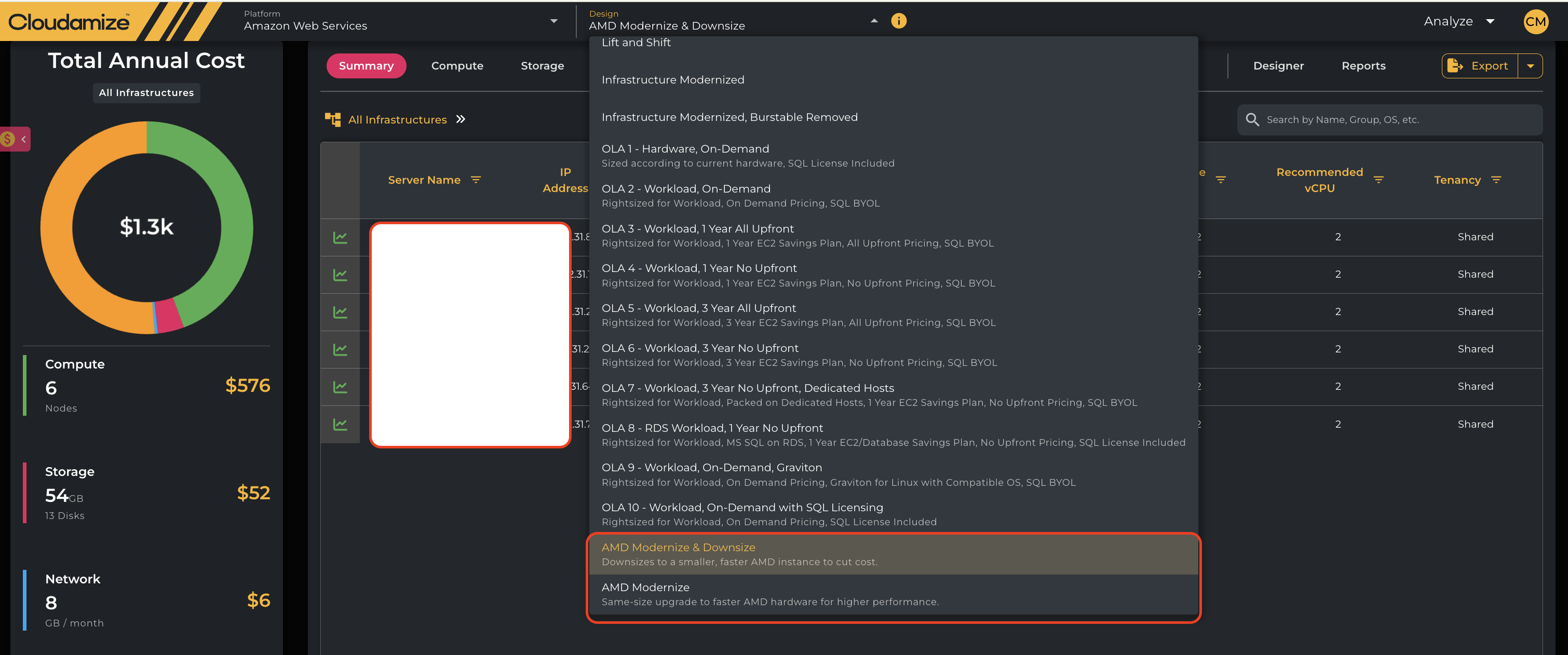
1. AMD Modernize & Downsize
-
Description: Downsizes the target workload to a smaller, faster AMD instance family to cut overall compute costs.
-
Sizing Logic & Strategy: Evaluates observed CPU, RAM, and storage utilization. Leverages the higher per-core performance of modern AMD processors to safely downsize vCPU allocations while sustaining or improving workload performance.
-
Primary Business Outcome: Cost Reduction & Efficiency. Maximizes savings by reducing the instance size footprint without sacrificing operational stability.
2. AMD Modernize
-
Description: Performs a same-size upgrade to faster, next-generation AMD hardware for higher overall performance.
-
Sizing Logic & Strategy: Maintains the equivalent vCPU and memory footprint as the source asset (or baseline target), upgrading directly to current-generation AMD instance families.
-
Primary Business Outcome: Maximum Performance & Throughput. Boosts processing speed, IOPS, and application performance for mission-critical or compute-heavy workloads without altering core allocation ratios.
AMD Benchmark Mapping & Workload Logic
The recommendation engine leverages specialized AMD performance benchmarks to accurately right-size target compute environments:
-
Specific Workload Benchmarks: Sizing calculations use dedicated AMD benchmark profiles for target applications running NGINX, Stream, Java, FFmpeg, PostgreSQL, Redis, and MySQL.
-
Generalized Workload Baseline: For all other application and OS workload types not explicitly listed in the benchmark matrix, Cloudamize applies a standardized averaged AMD benchmark calculation.
-
Fallback & Instance Selection: The engine first attempts to retrieve source benchmarks within the active OLA plan. If source benchmarks are missing or unlisted, Cloudamize enforces all available AMD instance families across the target cloud provider to determine the best fit.
Note on Benchmark Precision:
Workloads running NGINX, Stream, Java, FFmpeg, PostgreSQL, Redis, or MySQL are mapped against precise workload-specific AMD benchmarks. All other workloads seamlessly utilize an averaged AMD benchmark profile to ensure accurate sizing across the entire inventory.
If you have any queries, please get in touch with the helpdesk via our Helpdesk Portal or by email at helpdesk@cloudamize.com.